Spec. Dev. Ship. Repeat.

Build real products, really fast, without losing control.

A proven set of AI agent skills for building real products. Spec effortlessly, dev less, ship more. Apps, games and creative projects alike.

Spec-driven development for AI coding agents

Turn “describe what you want” into a workflow you can trust.

SpecDevShip is a Skill Pack of 19 purpose-built skills that wraps your AI coding agent in a real spec-driven pipeline — triage, tier decisions, root-cause investigation, and approval gates that actually hold. Built for solo developers shipping products they'll still be maintaining in a year.

Continuously improved through real use

Start in minutes. Keep shipping for years.

Buy once and every improvement is yours: new skills, sharper workflows and new agent editions, shaped by real projects.

Spec-driven skills for AI coding agents

For those who like to ship.

Ship better products, faster, with confidence.

Adaptive by design

A revolutionary workflow that tailors itself to you.

A quick fix gets a one-page plan. A new app gets requirements, design and tasks. A mystery bug gets a real investigation first. It picks the right path for each job, so you never carry more process than the work needs.

Claude Code Edition — available now More agents — coming soon

pipeline
IdeaTriage & tier decision
Investigate / AnalyzeBug’s root cause — or research on an existing app, design, or product
SpecLight plan, or full requirements→tasks
Approve & buildGate holds; per-task commits
ShipWrap-up, changelog, semver
See the full workflow ↓
The process

Three steps. Repeat as needed.

  1. 1

    Spec

    Say what you want. Get a plan you approve.

  2. 2

    Dev

    Your agent builds it, task by task, commit by commit.

  3. 3

    Ship

    Walkthrough, changelog and version, done for you.

  4. Repeat

    Next feature. Next fix. Next release.

The problem

Vibe-coding has a ceiling.

Your AI coding agent will happily generate a confident, plausible plan for the wrong problem at the same speed it generates the right one. Without a system wrapped around it, that speed works against you.

01

No paper trail

Decisions live in a chat that scrolled past. Three weeks later, nobody — including the AI — can tell you whether something was a deliberate call or a guess that happened to compile.

02

No brake pedal

Left alone, an AI agent doesn't reliably tell "add a button" from "redesign the data model." Small requests quietly become big changes mid-implementation.

03

No root cause

“Probably a race condition” is a shrug with technical vocabulary. Fixes get proposed before the actual cause is ever found.

How it works

One pipeline, from idea to shipped.

Every piece of work enters through intake, gets explicitly scoped, and hands off automatically to the next stage — the way a disciplined teammate would, without you having to remember the process yourself.

workflow.mmd
flowchart TD
    idea(["idea"]) --> analysis["idea-analysis<br/>product.md check, then<br/>build, investigate, analyze, or<br/>set creative direction first?<br/>plan mode — wait for go-ahead"]
    idea -. "any time" .-> handoff["handoff<br/>export context to a<br/>new session/agent"]

    analysis -->|"bug, unknown cause"| investigate["investigate"]
    investigate --> findings["./investigations/&lt;name&gt;/findings.md"]
    findings --> back1["back to idea-analysis —<br/>scopes the fix into its own<br/>./spec/&lt;name&gt;/ folder"]
    back1 --> tier{"Tier?"}

    analysis -->|"existing app/design/art/product,<br/>understand it first"| explore["app-analysis /<br/>design-analysis /<br/>art-analysis /<br/>product-analysis"]
    explore --> findings2["./analysis/&lt;name&gt;/<br/>*-findings.md, art-bible.md, product.md"]
    findings2 --> back2["back to idea-analysis —<br/>scopes the work (Design-First)<br/>into its own ./spec/&lt;name&gt;/ folder"]
    back2 --> tier

    analysis -->|"need to originate new<br/>design/art direction"| direct["design-direction /<br/>art-direction<br/>(pre-production)"]
    direct --> predocs["./pre-production/&lt;name&gt;/<br/>design-system.md, art-bible.md"]
    predocs --> back3["back to idea-analysis —<br/>scopes the work into its own<br/>./spec/&lt;name&gt;/ folder"]
    back3 --> tier

    analysis -->|"genuinely new product,<br/>no product.md yet"| proddir["product-design<br/>(dialogue, not delegated<br/>autonomy)"]
    proddir --> proddoc["./spec/&lt;founding&gt;/product.md"]
    proddoc --> back4["back to idea-analysis —<br/>continues scoping with<br/>product.md in hand"]
    back4 --> tier

    analysis -->|"clear feature or fix"| tier

    tier -->|"Light — default"| plan["spec-plan<br/>implementation_plan.md<br/>draft → approve"]
    tier -->|"Full — rare"| fulltier{"Requirements-First or<br/>Design-First?"}

    req["spec-requirements"]
    fulltier -->|"blank slate"| req
    fulltier -->|"existing app/design/art<br/>to ground it in"| explore2["app-analysis /<br/>design-analysis /<br/>art-analysis /<br/>product-analysis<br/>(if not already run)"]
    explore2 --> req

    subgraph full["Full tier — new app / major architecture"]
        direction LR
        req --> tech["spec-tech"] --> design["spec-design"] --> tasks["spec-tasks"]
    end
    tasks -. "spec-sync after edits" .-> sync(("sync"))

    plan --> implement["implement-tasks<br/>implement → verify → check off → commit"]
    full -->|"plan approved"| implement

    implement --> wrap["wrap-up<br/>walkthrough.md, README,<br/>CHANGELOG under Unreleased"]
    wrap --> release["prepare-release — on request<br/>semver bump, cuts Unreleased into a version,<br/>RELEASE_NOTES.md"]
01 Idea Analysis — triage & tier decision 02 Investigate / Analyze / Direct — unknown cause, existing material, or a new product or creative direction 03 Spec — light plan, or requirements→tech→design→tasks 04 Implement — checklist-driven, per-task commits 05 Wrap-up & Release — walkthrough, changelog, semver
What's inside

19 skills, each doing one job well.

Not a single mega-prompt — a set of specialists that hand off to each other, the way a real team divides work.

Triage

Two tiers, so small stays small

Most work is light tier: one plan, one focused test script. Only genuine new-architecture work escalates to the full requirements → tech → design → tasks pipeline.

Diagnosis

Investigate before you fix

Bug reports get a real root-cause investigation, cited to file and line, before any fix is proposed — never a guess dressed up as a diagnosis.

Analysis

Reverse-engineer before you extend

App, design, art, and product-identity analysis skills extract what actually exists before a redesign or extension gets specced against a half-remembered impression.

Origination

Product, design & art as real roles

A structured Product Manager interview for new ideas; a Designer and Art Director that pitch real directions, get your pick, then run with full autonomy.

Governance

Approval gates that hold

Every spec carries draft/approved status. Nothing gets silently edited out from under you once you've signed off on it.

Shipping

Wrap-up & release, automatically

Walkthroughs, changelog entries, and semver bumps derived straight from your commit history — no separate release ritual to remember.

Not just SaaS

Built for anything you make.

Games, creative tools, art projects, apps. If it ships, it fits.

GAMES

Mechanics, not guesswork

Spec the loop, build it in small steps, and find the real cause when physics breaks.

CREATIVE

An Art Director on call

Pitches real visual directions, takes your pick, then runs with it. Or matches a style you already love.

PRODUCTS

Apps, sites and SaaS

From MVP to version 2.0, with a paper trail you can still read a year later.

Who's behind it

Made by an experienced software engineer.

Continuously improved by a working developer who uses it every day, for real work.

I started my career in QA at Intel and worked my way up to Software Engineer. After Intel, I developed games relentlessly for experiential marketing agencies, then became Head of Core Tech and Studio Lead Engineer at two different game studios, and later founded my own studio.

SpecDevShip draws on every one of those chapters: QA’s habit of chasing down the real cause, an engineer’s respect for a paper trail, agency deadlines that don’t move, and the game industry’s drive to ship.

— Corey Struzan coreystruzan.com ↗

  1. QA
  2. Software engineer
  3. Games
  4. Head of Core Tech
  5. Studio founder
Case study

I built my own site with it in one day.

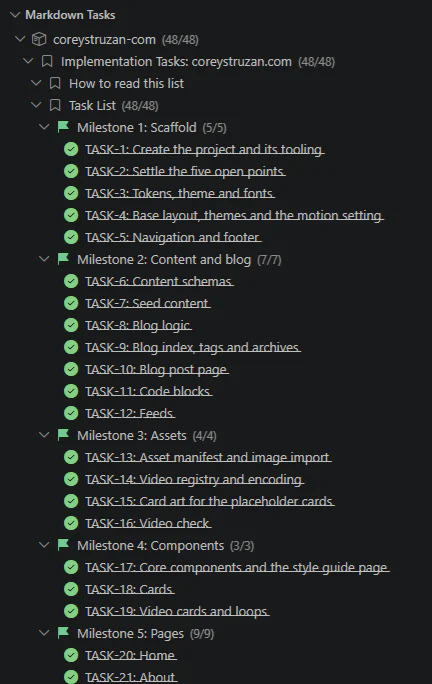
coreystruzan.com took one day of work to build. I made the decisions and gave feedback. The agents wrote the specs, built it task by task, and still keep it running.

1 day
of work to build it
48 of 48
planned tasks finished
0 lines
of code fixed by hand
Read the case study
The Markdown Tasks panel in VS Code for coreystruzan.com, showing 48 of 48 implementation tasks ticked off under their milestones: Scaffold, Content and blog, Assets, Components and Pages.
One workflow, every agent

One seamless workflow. Works everywhere your agent runs.

The tier decision, the investigation discipline, and the approval gates aren't tied to any one AI coding agent — they're the workflow itself. Editions ship one at a time; this page updates as each one goes live.

Claude Code Available now Also in VS Code, free
Next edition Coming soon

Buy once, and every future agent edition of the Skill Pack is included as a free update — for as long as SpecDevShip keeps this product actively maintained and for sale. See the Terms for the full "lifetime updates" definition.

Right-sized, every time

Light tier for most work. Full tier when it counts.

Light tier (most work)Full tier (rare)
WhenFeatures, fixes, UI work, refactorsNew app, or real new architecture/risk
Outputimplementation_plan.mdrequirements.md → tech.md → design.md → tasks.md
TestingFocused regression script + manual checksCoverage-targeted automated suite
Quick start

Get started in minutes. Ship in hours, not days.

  1. Minute 1

    Get the pack

    Connect GitHub and clone the repo.

  2. Minute 3

    Drop it in

    Copy the template into your project and/or add the skills to your agent.

  3. Minute 5

    Say what you want

    Your agent specs it, builds it and ships it.

Then keep going. Updates for life, included. See pricing ↓

Free for VS Code

Try the workflow free, right in your editor.

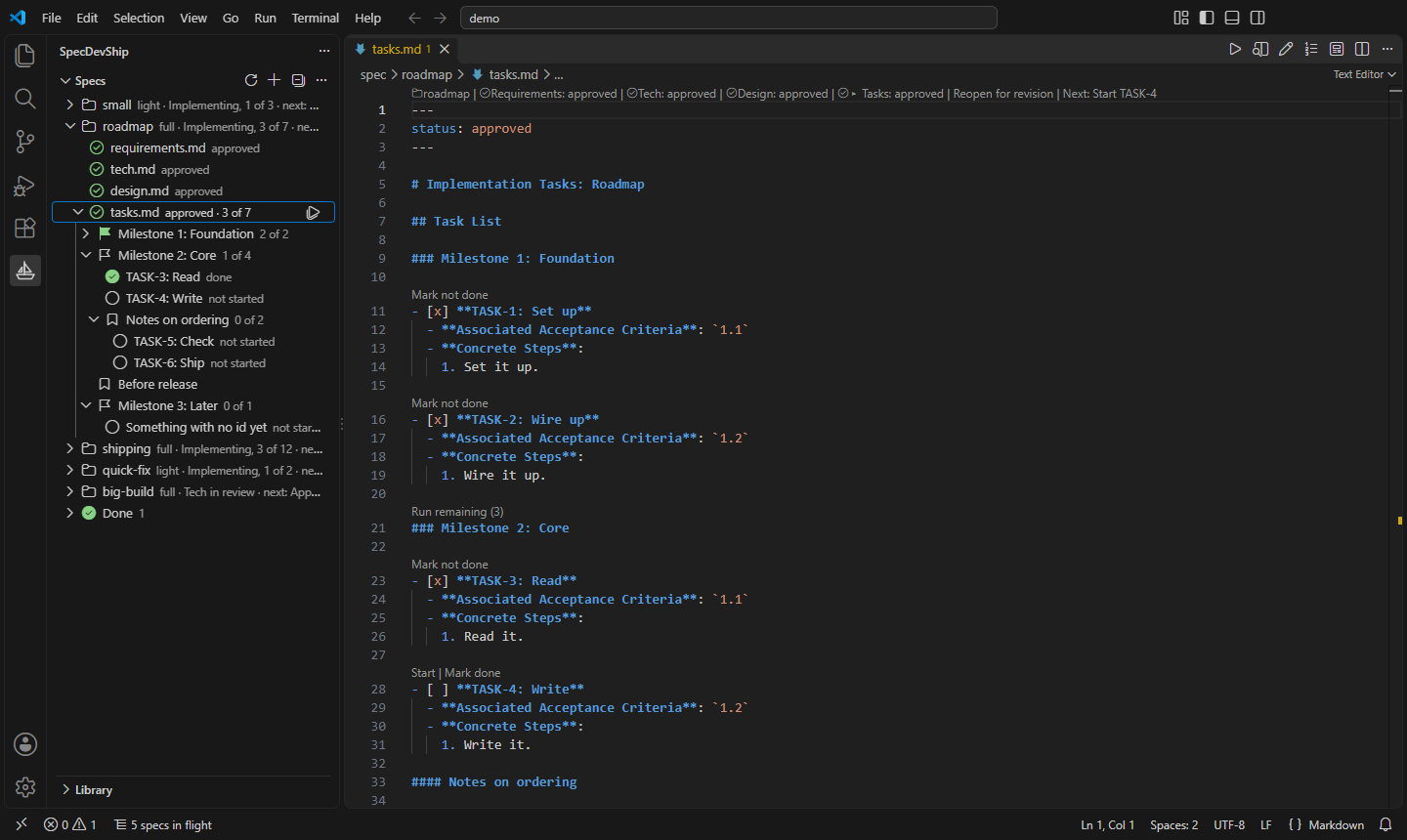
The SpecDevShip extension for VS Code is free. It shows every spec and where it stands, lets you approve documents and start tasks from the sidebar, and hands the work to Claude Code. It comes with SpecDevShip Skill Pack Lite: four skills for everyday features and fixes on small to medium projects. For bigger work, the full Skill Pack adds the full tier and 15 more skills.

Works with Claude Code. Makes no network requests and collects no data.

VS Code with the SpecDevShip Specs view open: each spec with its tier, stage and progress, and a spec's documents and tasks.
For those who like to ship

Start free. Go full when the work is bigger.

The field guide walks through the whole system in plain language. Skill Pack Lite runs the light tier free in VS Code; the full pack adds everything else, and drops straight into your own project.

Free field guide $0

A practical eBook covering the tier-decision framework, the investigate-before-you-fix discipline, and how approval gates work day to day.

  • The full workflow, explained end to end
  • The reasoning behind each design decision
  • No pack installation required to read it

Delivered by email. Unsubscribe anytime.

Skill Pack Lite $0

Four skills that run the light-tier workflow end to end, set up by the free SpecDevShip extension for VS Code.

  • Idea → plan → implement → wrap up, with your approval at each step
  • Claude Code, in VS Code
  • Upgrade to the full pack any time
Get the free extension →

Free under PolyForm Shield 1.0.0. More on the Skill Pack Lite page.

FAQ

Before you ask.

Does this only work with Claude Code?

Right now, yes — the Skill Pack currently ships as the Claude Code Edition, a drop-in project template plus personal account skills. Editions for other AI coding agents are planned; see the Agents section above for what's currently supported.

If I buy now, do I get future agent editions too?

Yes. Every future edition of the Skill Pack — for whichever agents we add support for next — is included as a free update to your existing $49 purchase, for as long as this product remains actively maintained and for sale. It doesn't extend to unrelated future SpecDevShip products; full definition in the Terms.

Is this overkill for a small project?

For a one-off script, yes — skip it. It earns its keep on anything you'll still be maintaining in six months, where an undocumented decision or an unfindable root cause actually costs you time. For small to medium projects, start with the free Skill Pack Lite in VS Code. It's the light tier on its own, with no full-tier process to skip.

What's the difference between the free guide and the paid pack?

The field guide explains how the workflow thinks — the tier decision, the investigation discipline, the approval gates. The pack is the thing itself: all 19 skills, installed and running in your own project.

What's the difference between Skill Pack Lite and the full pack?

Lite is four skills for the light tier: idea analysis, a plan, implementation and wrap-up. The full pack is all 19, adding the full tier for new apps and new architecture, dedicated bug investigation, analysis of existing apps and designs, product, design and art direction, and release preparation. See the side-by-side comparison.

Do I need to follow every skill, every time?

No. Idea Analysis routes you automatically — most work only ever touches the light-tier plan skill. The full pipeline and the origination skills (product, design, art direction) only come up when the work actually calls for them.

Is it a subscription?

No. The skill pack is a one-time $49 purchase with lifetime updates. The field guide is free.

Can I get a refund?

Yes. If the Skill Pack isn't right for you, ask for a full refund within 14 days of buying, for any reason. Just keep in mind that a refund ends your access to the repository and to all future updates and agent editions, and that pre-launch pricing and discounts may not be available if you buy again later. Details are in the Terms.
From the blog

Still deciding? Go a layer deeper.

Three places to start — how the tier decision actually works, what shipping an MVP with it looks like, and the full case for ditching vibe-coding.